Quick Conversions
Aluminum LME Price Today — 10-Day India Trend
All prices in ₹ per gram · daily rate, updated once per day
Aluminum LME Price Today: what Indian buyers are really looking at
The aluminum LME price today matters because it sits at the centre of global price discovery, and Indian market quotes usually orbit around it. As of September 17, 2026, the live aluminium rate on this page stands at ₹0.29 per gram, which gives traders, stockists, fabricators and procurement teams a clean benchmark before they negotiate actual landed or ex-warehouse deals. That is the practical use of the number. It tells you where the metal starts, not where every finished product will finally bill out.
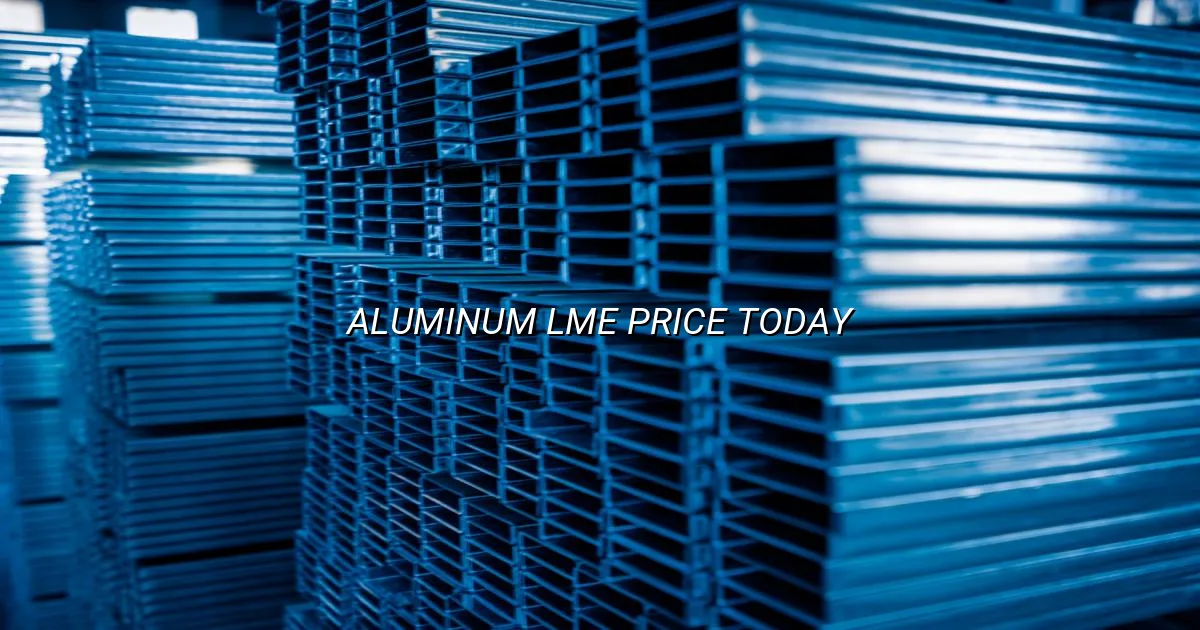
For Indian users, the raw LME aluminium benchmark does not operate in isolation. MCX aluminium futures translate that global move into rupee terms, and the market then layers in currency movement, duty, freight and physical premium. So if someone searches for aluminum lme price today, what they usually want is not a London quote in a vacuum; they want to understand the aluminium bhav that will affect buying in Delhi, Ahmedabad, Pune, Coimbatore or Rajkot.
Live aluminium values at standard weights
- 1 gram: ₹0.29
- 10 grams: ₹2.87
- 100 grams: ₹28.68
- 1 kg: ₹286.81
- 1 metric tonne: ₹286,811.00
That last figure matters more than the per-gram number for most industrial users, because aluminium moves in volume. Foil plants, extrusion units, die casters and cable manufacturers usually think in tonnes, not grams. Even so, breaking the price down to smaller units helps smaller traders and retail users compare quotations quickly. It also makes MCX aluminium and LME aluminium moves easier to interpret on mobile without doing mental math every time the market shifts.
If you are comparing today with yesterday, keep one thing in mind: exchange-led price moves can be sharp, but physical market pass-through is not always instant. A stockist holding older inventory may quote differently from a trader booking fresh metal against the latest LME aluminium move. That gap, small or wide, is where real purchasing decisions happen.
Aluminum LME Price Today by Gram, Kg and Tonne
Today's Aluminium rate is Less than One Rupees per gram. At this rate, 10 grams of Aluminium costs Three Rupees.
| Unit | Weight | Price (INR) | Price in Words |
|---|---|---|---|
| 1 Gram | 1.0000 g | ₹0.29 | Less than One Rupees |
| 8 Grams | 8.0000 g | ₹2.29 | Two Rupees |
| 10 Grams | 10.0000 g | ₹2.87 | Three Rupees |
| 100 Grams | 100.0000 g | ₹28.68 | Twenty Nine Rupees |
| 1 Kilogram | 1,000.0000 g | ₹286.81 | Two Hundred and Eighty Seven Rupees |
| 1 Ounce (oz) | 28.3495 g | ₹8.13 | Eight Rupees |
| 1 Troy Ounce | 31.1035 g | ₹8.92 | Nine Rupees |
| 1 Metric Ton | 1,000,000.0000 g | ₹286,811.00 | Two Lakh Eighty Six Thousand Eight Hundred and Eleven Rupees |
How the LME benchmark turns into the aluminium rate quoted in India
The jump from an LME screen price to an Indian invoice is not mysterious, but it is not one-step either. Dealers begin with LME grade A aluminium, usually the cleanest global reference for primary aluminium. From there, the market converts the dollar-denominated rate into rupees, adjusts for USD/INR, and then adds the local cost structure that importers and processors actually face. That is why the aluminum lme price today is a benchmark, while the aluminium spot price in India is a usable commercial rate.
Why MCX, duty and currency matter so much
MCX aluminium futures give Indian participants the most direct local trading signal. If the LME aluminium contract rises overnight but the rupee strengthens meaningfully, the domestic move may look smaller than expected. Reverse that setup and the Indian rate can move harder than the global chart suggests. Add roughly 7.5% basic customs duty and GST into the landed cost equation, and you start to see why two people looking at the same LME headline can still arrive at different transaction prices inside India.
Energy costs matter too, and this is where the market gets blunt. Aluminium smelting eats power. A lot of it. Any shift in coal prices, power tariffs, or energy policy can influence production economics. China still accounts for around 60% of global primary aluminium output, so changes in Chinese smelter utilisation, output caps, or seasonal power curbs can push LME aluminium fast. Indian buyers feel that downstream, even if the local warehouse clerk never mentions China while quoting an aluminium ingot price.
Primary metal, scrap and alloy grades do not trade at one flat number
Primary aluminium and secondary aluminium are not interchangeable from a pricing standpoint. Primary metal, the kind tied more closely to LME grade A standards, carries higher purity and is preferred where conductivity, formability or consistency really matter. Electrical cable, foil stock and certain engineering applications fall in that bucket. Aluminium scrap price, by contrast, often trades at a discount because contamination, alloy mix and recovery losses can materially change what the buyer actually gets. Cheaper per kg, yes. Equivalent, not always.
Then come alloy premiums. An aluminium alloy such as 6061 used in structural and engineering applications does not behave like a plain commodity ingot. Nor does 1100 series material used in simpler sheet and foil applications. The base rate may start with the live aluminium price today India benchmark, but the final quote for aluminium sheet price, aluminium foil price or extrusion billet can move higher depending on alloying elements, rolling charges, conversion cost, width, thickness and delivery terms. That difference trips up first-time buyers more often than you would think.
Demand is changing as well. The packaging sector is pulling more aluminium into foil, lids and containers. Construction keeps using it in window frames, facades and roofing. Automotive lightweighting, especially around EV components and body panels, adds another layer of medium-term support. India’s infrastructure push under the National Infrastructure Pipeline is part of that demand story too. Not all at once, and not every week, but steadily enough that buyers who ignore the benchmark usually end up buying blind.
Aluminum LME Price Today — Last 10 Daily Rates
The most recent Aluminium price on record (2026-09-17) is Less than One Rupees per gram.
| Date | Price (INR/g) | Change |
|---|---|---|
| 2026-09-17 | ₹0.29 | +0.00 |
| 2026-09-16 | ₹0.29 | +0.00 |
| 2026-09-15 | ₹0.28 | +0.00 |
| 2026-09-14 | ₹0.28 | 0.00 |
| 2026-09-13 | ₹0.28 | +0.00 |
| 2026-09-12 | ₹0.28 | 0.00 |
| 2026-09-11 | ₹0.28 | 0.00 |
| 2026-09-10 | ₹0.29 | 0.00 |
| 2026-09-09 | ₹0.29 | +0.00 |
| 2026-09-08 | ₹0.29 | — |
Reading the bigger picture behind aluminum LME price today
Aluminium is a cyclical industrial metal. That simple fact explains a lot of the frustration people feel when prices refuse to move in a straight line. Demand improves, inventories tighten, LME aluminium rises, and everyone starts talking about a durable uptrend. Then construction slows, manufacturing data weakens, China supply recovers, or the dollar firms up, and the market gives back part of the move. The benchmark does not care about sentiment for long. It cares about balance.
For Indian traders and procurement managers, the most sensible approach is to track both LME aluminium and MCX aluminium futures together rather than relying on one feed. LME gives the global pulse. MCX tells you how that pulse is being translated into rupees in a tradeable domestic format. If the two diverge noticeably, the usual suspects are currency, import cost assumptions, local sentiment or temporary physical tightness. That comparison is often more useful than staring only at a single spot number.
Seasonality plays a role, although not with perfect precision. Construction demand often improves before peak summer project activity. Packaging demand can firm around festive production cycles, especially where aluminium foil and container stock are involved. Monsoon periods, on the other hand, tend to create slower execution in some construction-linked segments. None of these factors override global supply shocks, but they do shape the short-term tone of the aluminium rate in India.
Domestic capacity is another piece of the story. India is not merely a passive price taker; major producers such as Hindalco and Vedanta give the country meaningful smelting presence. Even so, certain downstream categories, specialised alloys and specific physical forms can still be influenced by import parity thinking. That means local availability may improve without completely severing the link to the LME benchmark. In other words, more domestic supply helps. It does not make global pricing irrelevant.
Retail investors should be realistic here. Aluminium does not have the easy wrappers that gold enjoys in India. There is no sovereign bond equivalent for aluminium, and there is no widely adopted digital-metal SIP route for ordinary buyers. Exposure usually comes through MCX aluminium futures, through broader commodity funds that include base metals, or indirectly via listed companies connected to aluminium production and processing. That makes price tracking even more important, because the benchmark itself often becomes the first risk-management tool.
For businesses, the lesson is straightforward. Use the chart and history on this page to understand direction, not just the latest tick. If today’s move is part of a wider 10-day trend, procurement strategy may need to change. A fabricator buying every week has a different exposure profile from a trader carrying inventory for a month. One can average in; the other can get hurt by a quick downswing. That is why watching the aluminum lme price today in isolation is never enough. The context around it is where the real decision sits.
And that context can turn quickly. A surprise shift in Chinese smelter output, a jump in power costs, a stronger rupee, softer manufacturing data, or a visible inventory draw on global exchanges can all rewrite the short-term picture. Sensible buyers do not chase every spike, but they do keep the benchmark on screen. In this market, that habit usually pays for itself.
Aluminum LME Price Today — FAQs for Indian Buyers
The aluminum LME price today in India works out to ₹0.29 per gram as of September 17, 2026. On MetalsCost, this reflects the global LME aluminium benchmark translated into Indian rupees and aligned with local MCX aluminium pricing.
Using today's live rate, 1 kg aluminium is priced at ₹286.81. For large industrial buying, 1 metric tonne comes to ₹286,811.00 before fabrication, freight, and local taxes.
LME aluminium is the global benchmark for price discovery. MCX aluminium futures track that benchmark after adjusting for USD/INR movement, landed cost, and India's import structure, including roughly 7.5% basic customs duty and GST. If LME grade A aluminium moves sharply overnight, MCX aluminium usually reacts quickly in the next session.
No. LME aluminium refers to primary aluminium benchmark pricing, typically linked to LME grade A aluminium. Aluminium scrap price in India can trade below primary metal because scrap quality, alloy content, contamination, and recovery losses vary lot by lot.
The LME-linked rate is the raw metal benchmark. Aluminium ingot price may include freight and regional premiums, while aluminium sheet price adds rolling charges, alloy premiums, thickness tolerance, and stockist margin. That is why finished and semi-finished products rarely match the plain exchange-derived metal rate.
Fabricators, foil converters, cable manufacturers, window-profile dealers, packaging buyers, and small traders all benefit from tracking the aluminum LME price today. Even if they purchase locally, the benchmark helps them judge whether the aluminium bhav being quoted is fair.
