Quick Conversions
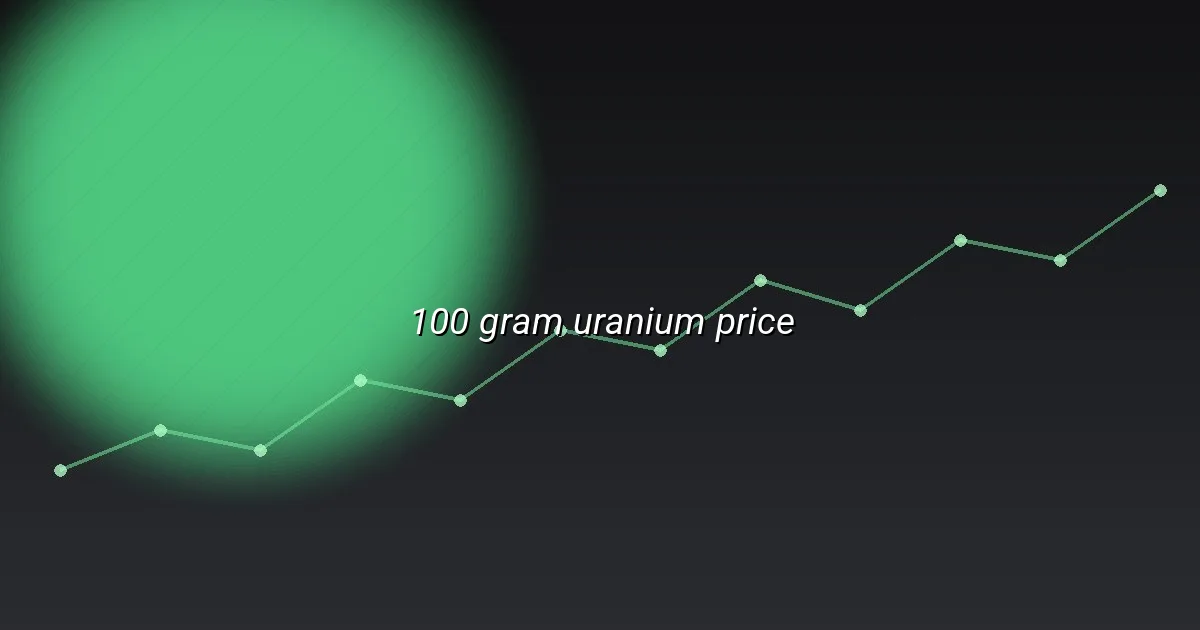
100 Grams of Uranium — 10-Day Price Track
All prices in ₹ per gram · daily rate, updated once per day
100 gram uranium price: where the numbers start feeling real
One hundred grams of uranium reference ₹1,729.36 today, September 16, 2026. Somewhere between the trivial gram and the serious kilogram, the hectogram is where uranium's price starts to register on ordinary financial intuition — roughly a smartphone's worth of metal, carrying a household-years' worth of locked energy.
The ladder around 100 grams:
- 10 grams: ₹172.94
- 50 grams: ₹864.68
- 100 grams: ₹1,729.36
- 250 grams: ₹4,323.39
- 1 kg: ₹17,293.57
Physically, 100 grams of uranium metal is a cube under two centimetres a side — denser than lead, smaller than a dice pair. As yellowcake powder it would barely cover the bottom of a teacup. The trade never handles such quantities; drums of concentrate move by the hundreds of kilograms, and contracts by the tonne.
100 Grams in the Full Unit Ladder
Today's Uranium rate is Seventeen Rupees per gram. At this rate, 10 grams of Uranium costs One Hundred and Seventy Three Rupees.
| Unit | Weight | Price (INR) | Price in Words |
|---|---|---|---|
| 1 Gram | 1.0000 g | ₹17.29 | Seventeen Rupees |
| 8 Grams | 8.0000 g | ₹138.35 | One Hundred and Thirty Eight Rupees |
| 10 Grams | 10.0000 g | ₹172.94 | One Hundred and Seventy Three Rupees |
| 100 Grams | 100.0000 g | ₹1,729.36 | One Thousand Seven Hundred and Twenty Nine Rupees |
| 1 Kilogram | 1,000.0000 g | ₹17,293.57 | Seventeen Thousand Two Hundred and Ninety Four Rupees |
| 1 Ounce (oz) | 28.3495 g | ₹490.26 | Four Hundred and Ninety Rupees |
| 1 Troy Ounce | 31.1035 g | ₹537.89 | Five Hundred and Thirty Eight Rupees |
| 1 Metric Ton | 1,000,000.0000 g | ₹17,293,573.00 | One Crore Seventy Two Lakh Ninety Three Thousand Five Hundred and Seventy Three Rupees |
The hectogram as a thinking tool
Why bother pricing a quantity nobody trades? Because 100 grams is the scale at which uranium's economics become mentally comparable with daily life. A hectogram of uranium costs about what a family spends on a weekend outing; the electricity eventually traceable to it would run that family's home for years. No other substance in commerce offers that ratio — and seeing it at human scale, rather than in abstract tonnes, is what makes the nuclear energy argument click for most people.
From 100 grams to national programmes
Scale the hectogram by ten thousand and you reach the tonne — the unit of mine output and reactor demand. India's reactors consume the equivalent of millions of hectograms yearly; the 100 GW ambition multiplies that severalfold by 2047. Every one of those future hectograms will be priced, directly or through contract formulas, off the benchmark this page converts daily. Small unit, straight line to national strategy.
The hectogram also clarifies the cost structure of nuclear fuel. At ₹1,729.36 for the raw material, 100 grams of finished reactor fuel — converted, enriched (where applicable), fabricated — costs several times more. Yet even that finished figure, divided across the thousands of kilowatt-hours it generates, contributes only paise per unit of electricity. Fuel cheapness per kWh is nuclear power's quiet superpower, visible at any scale you choose to examine it.
The boring legal note, still mandatory
No quantity exemption softens the Atomic Energy Act, 1962: one hundred grams of uranium is as illegal for private hands as a hundred tonnes. The figure on this page is a market reference for understanding and analysis. India's hectograms belong to UCIL, the DAE and the reactors — not to lockers.
100 Gram Uranium Price — Daily Log
The most recent Uranium price on record (2026-09-16) is Seventeen Rupees per gram. This is up by Less than One Rupees from the previous day's rate of ₹17.28.
| Date | Price (INR/g) | Change |
|---|---|---|
| 2026-09-16 | ₹17.29 | +0.01 |
| 2026-09-15 | ₹17.28 | +0.03 |
| 2026-09-14 | ₹17.25 | +0.03 |
| 2026-09-13 | ₹17.22 | +0.00 |
| 2026-09-12 | ₹17.22 | +0.01 |
| 2026-09-11 | ₹17.21 | -0.01 |
| 2026-09-10 | ₹17.22 | +0.09 |
| 2026-09-09 | ₹17.14 | +0.08 |
| 2026-09-08 | ₹17.06 | +0.05 |
| 2026-09-07 | ₹17.01 | — |
Tracking the 100-gram line
The hectogram's chart is the benchmark's chart, amplified a hundredfold into rupee figures that register. A two percent benchmark move — invisible at gram scale — shifts the 100-gram price by a noticeable sum. For readers building intuition about uranium's volatility, this is the friendliest scale to watch: big enough to feel, small enough to stay comprehensible.
Use the comparisons above the way the market does: the week's move is noise plus currency; the month's move is drift; the year's move is regime. Uranium's defining rallies and routs all announced themselves first in the twelve-month figure while daily commentary argued about nothing. The hectogram simply makes those moves easier to read in rupees.
And when a headline eventually claims some seized pouch of powder is "uranium worth lakhs per 100 grams", you now own the refutation: the real number is on this page, updated daily, and it is nowhere near. Benchmark arithmetic beats breathless reporting — at any weight.
100 Gram Uranium Price — Scaled-Up Answers
One hundred grams reference ₹1,729.36 on September 16, 2026 — the per-gram benchmark of ₹17.29 scaled up. Comparable to a mid-range smartphone in cost, and to a small power station's day in consequence.
Its fissile content, run through a conventional reactor, eventually yields around 4,000–5,000 kWh of electricity — a typical Indian household's consumption for two to four years, depending on usage.
Not remotely. Real transactions move in tonnes; assessment-grade spot parcels run to tens of thousands of pounds. One hundred grams is an analytical unit — useful for comparison, invisible to the trade.
Silver at roughly ₹100/g puts the 100-gram bar near ₹10,000; uranium's 100 grams cost ₹1,729.36. Silver you can hold, gift and resell; uranium you can only read about — the Atomic Energy Act, 1962 sees to that.
No — it is the benchmark times one hundred, nothing more. All dynamics belong to the underlying U3O8 assessment and the USD/INR rate. The chart above shows their combined daily effect.
