Quick Conversions
Gold Bullion Price — 10-Day Trend
All prices in ₹ per gram · daily rate, updated once per day
Gold Bullion Price in India Today — Bars and Biscuits
The gold bullion price in India today stands at ₹15,031.44 per gram for 999 (24K) purity as of September 14, 2026. This page tracks bullion specifically — investment-grade bars and biscuits, the form most banks, refiners and bullion dealers sell for holding value, as distinct from coins (see our gold coin rate page) or retail jewellery.
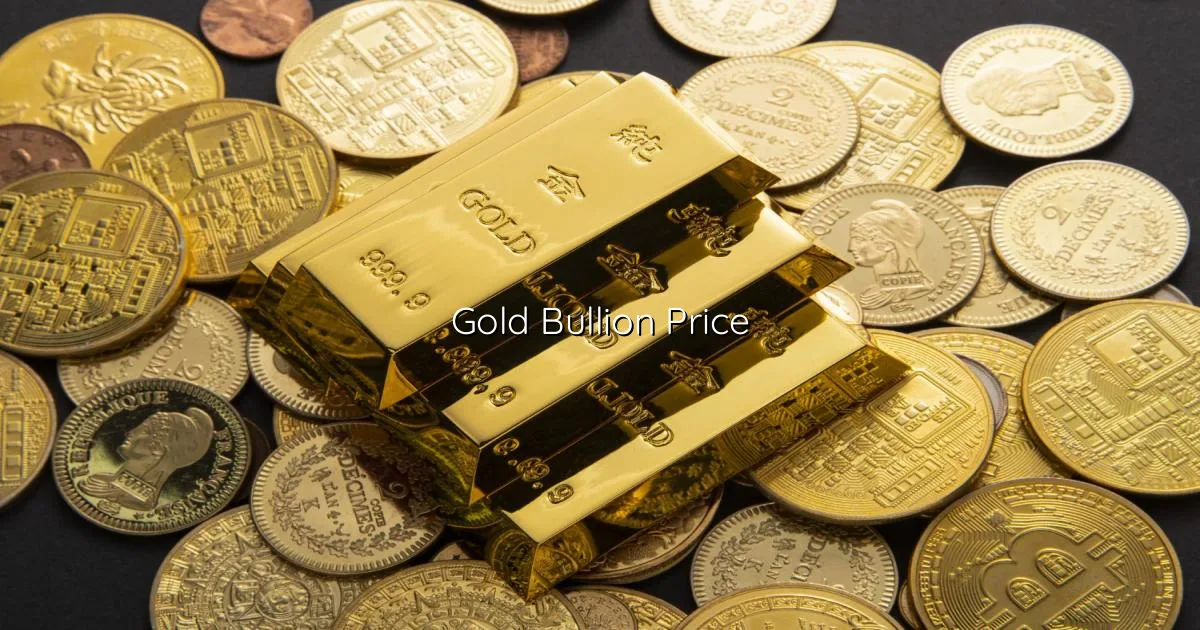
Bullion is sold in standard bar/biscuit weights — commonly 5g, 10g, 20g, 50g, 100g and 1kg — and always in 24K (999 or 999.9 fineness), never a lower karat, because a bar's entire purpose is metal content, not wearability:
- 10 gram bar: ₹150,314.40
- 100 gram bar: ₹1,503,143.98
- 1 kg bar: ₹15,031,439.79
This benchmark tracks the global spot price, then gets nudged by the rupee, import duty and dealer premium — the same chain that feeds MCX gold. What changes bar to bar is the premium a dealer adds over that spot number, and that premium is the real story on this page.
Gold Bullion Price by Weight
Today's Gold rate is Fifteen Thousand Thirty One Rupees per gram. At this rate, 10 grams of Gold costs One Lakh Fifty Thousand Three Hundred and Fourteen Rupees.
| Unit | Weight | Price (INR) | Price in Words |
|---|---|---|---|
| 1 Gram | 1.0000 g | ₹15,031.44 | Fifteen Thousand Thirty One Rupees |
| 8 Grams | 8.0000 g | ₹120,251.52 | One Lakh Twenty Thousand Two Hundred and Fifty Two Rupees |
| 10 Grams | 10.0000 g | ₹150,314.40 | One Lakh Fifty Thousand Three Hundred and Fourteen Rupees |
| 100 Grams | 100.0000 g | ₹1,503,143.98 | Fifteen Lakh Three Thousand One Hundred and Forty Four Rupees |
| 1 Kilogram | 1,000.0000 g | ₹15,031,439.79 | One Crore Fifty Lakh Thirty One Thousand Four Hundred and Forty Rupees |
| 1 Ounce (oz) | 28.3495 g | ₹426,133.80 | Four Lakh Twenty Six Thousand One Hundred and Thirty Four Rupees |
| 1 Troy Ounce | 31.1035 g | ₹467,530.39 | Four Lakh Sixty Seven Thousand Five Hundred and Thirty Rupees |
| 1 Metric Ton | 1,000,000.0000 g | ₹15,031,439,791.00 | One Thousand Five Hundred and Three Crore Fourteen Lakh Thirty Nine Thousand Seven Hundred and Ninety One Rupees |
Purity Certificates and Dealer Premiums
Every legitimate bullion bar or biscuit ships with a purity/assay certificate stating its fineness (999 or 999.9), serial number, and the refiner's name — usually a LBMA-accredited refiner for larger bars, or a BIS-registered one for bars sold to Indian retail. That certificate, not the seller's word, is what makes the bar resellable at close to spot later. Always match the serial number on the certificate to the number stamped on the bar itself before you pay.
Why a 10g bar and a 1kg bar don't carry the same premium
Dealers add a premium over the spot rate to cover minting, assaying, certification and handling — and that premium does not scale evenly with weight. A 1 kg bar spreads its fixed minting and certification cost across a thousand grams, so its per-gram premium is thin. A 10 gram biscuit carries roughly the same fixed cost over far less metal, so its per-gram premium runs noticeably higher. This is the opposite of jewellery, where a heavier piece usually means more making-charge rupees, not less.
Because of this, serious bullion buyers with larger budgets generally get a sharper per-gram deal from bigger bars, while smaller biscuits exist mainly for buyers who want the format — a gift, a specific denomination — rather than the lowest possible premium.
Gold Bullion Price — Last 10 Days
The most recent Gold price on record (2026-09-14) is Fifteen Thousand Thirty One Rupees per gram. This is down by Two Hundred and Sixty Nine Rupees from the previous day's rate of ₹15,300.41.
| Date | Price (INR/g) | Change |
|---|---|---|
| 2026-09-14 | ₹15,031.44 | -268.97 |
| 2026-09-13 | ₹15,300.41 | 0.00 |
| 2026-09-12 | ₹15,300.41 | -46.74 |
| 2026-09-11 | ₹15,347.15 | +66.38 |
| 2026-09-10 | ₹15,280.77 | -141.47 |
| 2026-09-09 | ₹15,422.24 | +121.11 |
| 2026-09-08 | ₹15,301.14 | -1.46 |
| 2026-09-07 | ₹15,302.59 | -8.75 |
| 2026-09-06 | ₹15,311.34 | 0.00 |
| 2026-09-05 | ₹15,311.34 | — |
Bullion vs. Coins vs. Jewellery — Where Bars Fit
Bullion bars sit at the plain-investment end of physical gold. A coin (see our gold coin rate page) is easier to gift and comes in smaller, packaged denominations, but usually carries a slightly higher per-gram premium than a mid-size bar. Jewellery, including a piece like a gold chain, adds making charges and design cost on top, so it is rarely the efficient choice if the only goal is holding gold value. Bars are the middle ground: no making charges, no wastage, just metal plus a modest, size-dependent premium.
The trade-off with any physical form — bar, coin or jewellery — is storage and insurance. If that overhead matters more to you than holding the metal itself, a gold ETF or Sovereign Gold Bond tracks the same price without a locker. Our gold investments page compares all these routes side by side.
Gold Bullion Price — FAQs
The gold bullion price in India today is ₹15,031.44 per gram for 999 (24K) purity bars and biscuits as of September 14, 2026. Bullion is always sold at 24K — unlike jewellery, there is no 22K or 18K bar, since the whole point of bullion is metal content, not wearability.
The 10 gram gold bullion price today is ₹150,314.40 on a pure-metal basis as of September 14, 2026. A 10g biscuit will carry a somewhat higher per-gram dealer premium over this than a 100g or 1kg bar does.
A purity/assay certificate stating the fineness (999 or 999.9), a serial number matching the number stamped on the bar, and the refiner's name — an LBMA-accredited refiner for larger bars, or a BIS-registered one for retail-sized bars in India. Match the certificate's serial number to the bar before paying.
Minting, assaying and certification cost roughly the same in fixed rupee terms regardless of bar size, so that cost is spread over less metal on a small bar and more metal on a large one. A 1kg bar therefore usually has a thinner per-gram premium than a 10g biscuit.
A bullion dealer sells metal at spot plus a size-based premium. A jeweller adds making charges, wastage and design cost on top of the metal value, which is why a bar and a chain of the same weight never cost the same, even at identical purity.
Physical bullion gives you the metal in hand and no fund-management layer, but you carry storage and insurance cost yourself. A gold ETF or Sovereign Gold Bond tracks the same price without a locker; SGBs also pay 2.5% annual interest with their own lock-in structure. See our gold investments overview for the full comparison.
