Quick Conversions
Gold Spot Price — 10-Day Trend (Not a Stock Chart)
All prices in ₹ per gram · daily rate, updated once per day
"Gold Share Price" Usually Means a Company's Stock — Not This Rate
The live number above is gold's spot price — the market value of the metal itself, currently ₹15,288.77 per gram, the same reference used across every page on this site. If you searched "gold share price," there's a good chance you actually mean something different: the stock price of a company whose business is built around gold — a miner, a refiner, a jewellery retailer, or a lender that finances loans against gold. That number lives on the stock exchange, not on a bullion price feed, and it moves for reasons that have as much to do with a company's balance sheet as with the metal itself.
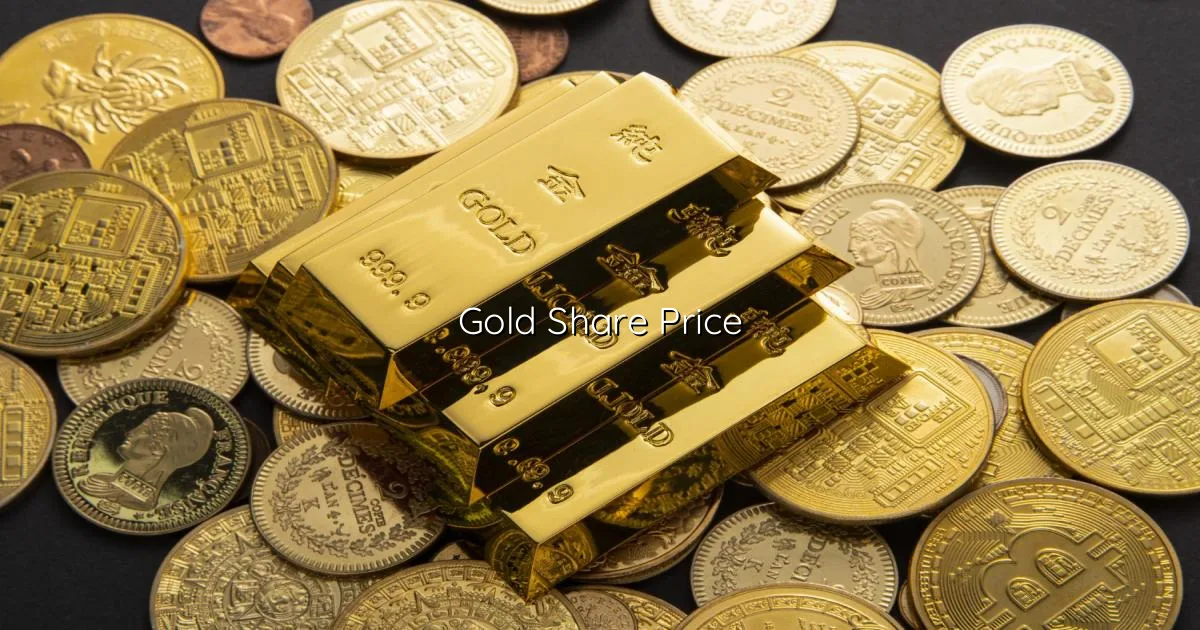
For reference, here's today's gold metal price by weight — useful context, but not what a "gold share" actually is:
- 24K gold (1 gram): ₹15,288.77
- 10 grams (24K): ₹152,887.66
- 1 kg (24K): ₹15,288,766.26
Keep those two ideas separate as you read on: the metal's spot price is what this whole site tracks daily. A gold-linked company's share price is a different market entirely, and that's what the rest of this page actually explains.
Gold Spot Price by Weight
Today's Gold rate is Fifteen Thousand Two Hundred and Eighty Nine Rupees per gram. At this rate, 10 grams of Gold costs One Lakh Fifty Two Thousand Eight Hundred and Eighty Eight Rupees.
| Unit | Weight | Price (INR) | Price in Words |
|---|---|---|---|
| 1 Gram | 1.0000 g | ₹15,288.77 | Fifteen Thousand Two Hundred and Eighty Nine Rupees |
| 8 Grams | 8.0000 g | ₹122,310.13 | One Lakh Twenty Two Thousand Three Hundred and Ten Rupees |
| 10 Grams | 10.0000 g | ₹152,887.66 | One Lakh Fifty Two Thousand Eight Hundred and Eighty Eight Rupees |
| 100 Grams | 100.0000 g | ₹1,528,876.63 | Fifteen Lakh Twenty Eight Thousand Eight Hundred and Seventy Seven Rupees |
| 1 Kilogram | 1,000.0000 g | ₹15,288,766.26 | One Crore Fifty Two Lakh Eighty Eight Thousand Seven Hundred and Sixty Six Rupees |
| 1 Ounce (oz) | 28.3495 g | ₹433,428.88 | Four Lakh Thirty Three Thousand Four Hundred and Twenty Nine Rupees |
| 1 Troy Ounce | 31.1035 g | ₹475,534.14 | Four Lakh Seventy Five Thousand Five Hundred and Thirty Four Rupees |
| 1 Metric Ton | 1,000,000.0000 g | ₹15,288,766,260.00 | One Thousand Five Hundred and Twenty Eight Crore Eighty Seven Lakh Sixty Six Thousand Two Hundred and Sixty Rupees |
What Actually Moves a Gold Mining Company's Share Price
Rajesh Exports is one of India's largest gold refining and jewellery manufacturing companies, listed and traded on the exchanges. Deccan Gold Mines is India's only listed pure-play gold exploration company — a much smaller, earlier-stage business. For companies like these, the share price is driven by their cost of production relative to the gold price — the mining industry's standard yardstick is "all-in sustaining cost" per ounce, which bundles extraction, processing, and the ongoing capital spend needed to keep a mine running. The gap between that cost and the market gold price is the margin the business actually earns.
Reserve size, new exploration results, debt on the balance sheet, and how well management executes all sit on top of that margin question. A mining stock can fall in a week gold rises if, say, the company reports weaker output or takes on more debt — and it can rally on a strong quarter even if gold itself is flat. It's also still a stock: a broad equity market selloff can drag a gold miner down regardless of what bullion is doing that day.
Gold Spot Price — Last 10 Days
The most recent Gold price on record (2026-09-17) is Fifteen Thousand Two Hundred and Eighty Nine Rupees per gram. This is up by Fifty Nine Rupees from the previous day's rate of ₹15,230.10.
| Date | Price (INR/g) | Change |
|---|---|---|
| 2026-09-17 | ₹15,288.77 | +58.66 |
| 2026-09-16 | ₹15,230.10 | +162.03 |
| 2026-09-15 | ₹15,068.07 | +36.63 |
| 2026-09-14 | ₹15,031.44 | -268.97 |
| 2026-09-13 | ₹15,300.41 | 0.00 |
| 2026-09-12 | ₹15,300.41 | -46.74 |
| 2026-09-11 | ₹15,347.15 | +66.38 |
| 2026-09-10 | ₹15,280.77 | -141.47 |
| 2026-09-09 | ₹15,422.24 | +121.11 |
| 2026-09-08 | ₹15,301.14 | — |
Jewellery Retailers and Gold-Loan Lenders — A Different Kind of "Gold Stock"
Titan Company (which owns Tanishq, India's largest jewellery retail brand) and Kalyan Jewellers India are both listed jewellery retailers, but their share prices track retail business metrics — same-store sales growth, store expansion, brand strength, and competition — not the gold rate directly. There's a real wrinkle here worth knowing: because jewellers hold large gold inventories, often financed through gold or metal loans, prevailing interest rates affect their cost structure. And a sharp rise in gold's spot price can actually dampen near-term jewellery buying volumes, even though it raises the value of what's sitting in inventory — so higher gold prices don't automatically mean a better quarter for a jewellery retailer's stock.
Muthoot Finance and Manappuram Finance are a third category entirely: NBFCs whose core business is lending against gold jewellery as collateral. Their share prices move with loan growth, interest rate spreads, and asset quality (how many borrowers repay on time) — gold's price matters to them mainly as a cushion behind their loan book, not as something their stock directly mirrors.
If You Want Exposure to Gold Itself, Not a Company
Owning shares in a gold miner, jewellery retailer, or gold-loan lender is a bet on that specific business — layered on top of, not identical to, a bet on gold's price. Over long periods, gold-mining equities have historically shown a positive but imperfect correlation with the gold price, and typically with sharper swings: because production costs are largely fixed in the short run, a given move in the gold price tends to produce a proportionally larger move in a miner's profit — and hence its stock — in either direction. That operating leverage is exactly what makes these stocks a different (and riskier) instrument than the metal itself.
If your actual goal is price exposure to gold — without taking on any single company's debt, execution, or demand risk — a Gold ETF or Sovereign Gold Bond tracks the metal directly. Digital gold does the same for smaller, more frequent purchases, and gold futures for traders who specifically want leveraged, short-term exposure to the metal. None of these carry a mining company's balance sheet or a retailer's quarterly sales numbers along with them.
Gold Share Price vs Gold Spot Price — FAQs
No — and this is the single most common mix-up on this topic. The gold rate (or gold spot price, shown live on this page at ₹15,288.77/g) is the market value of the metal itself. A gold share price is the stock price of a company whose business is linked to gold — a miner, refiner, jewellery retailer, or gold-loan lender — traded on a stock exchange like any other listed company.
A few distinct categories: jewellery retailers like Titan Company (which owns Tanishq) and Kalyan Jewellers India; Rajesh Exports, a large gold refining and jewellery manufacturing company; Deccan Gold Mines, India's only listed pure-play gold exploration company; and gold-loan NBFCs such as Muthoot Finance and Manappuram Finance, which lend against gold jewellery as collateral.
Not automatically. A higher gold price can help a miner's margins (if production costs stay flat) or lift a jeweller's inventory value, but each company also carries its own risks — debt, execution, competition, and even the possibility that a sharp price rise dampens jewellery buying volumes. A mining or jewellery stock can fall in a week gold rises, and vice versa.
Its cost of production relative to the gold price (the industry benchmark is "all-in sustaining cost" per ounce), the size and quality of its gold reserves, exploration results, debt levels, and how well management executes — plus, since it's a listed stock, the broader equity market's mood on any given day.
Their share price is driven by their lending business — loan growth, interest rate spreads, and asset quality (how many borrowers default) — not by gold's spot price directly. Gold prices matter to them mainly as collateral value: a falling gold price can squeeze their loan-to-value cushion, but that's a risk factor, not the same thing as their stock tracking the gold rate.
A Gold ETF or Sovereign Gold Bond tracks gold's own price without taking on any single company's business risk. Digital gold works the same way for smaller, more frequent purchases.
